

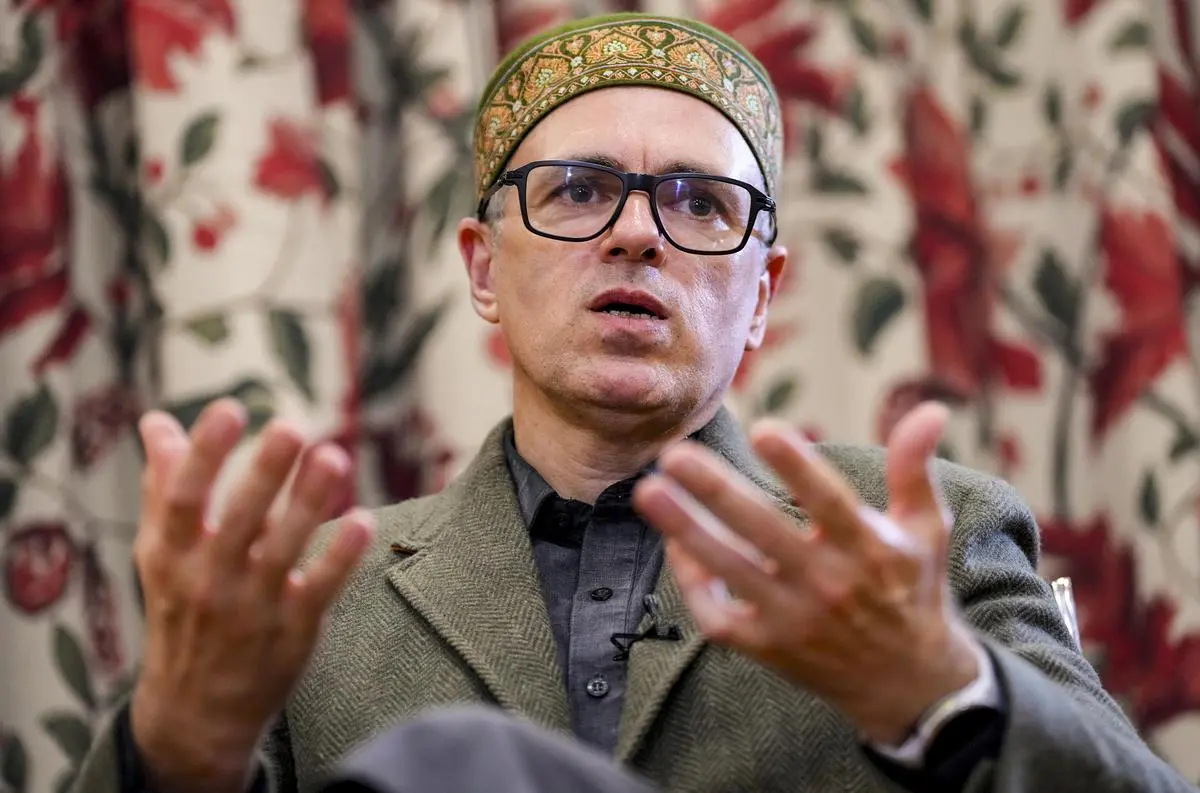
In an assertive statement on Friday, Jammu and Kashmir Chief Minister Omar Abdullah emphasized that the Tamil Nadu governor should allow Tamilaga Vettri Kazhagam (TVK) leader Vijay the chance to prove his majority in the assembly. Abdullah criticized Governor Rajendra Vishwanath Arlekar for denying Vijay’s request to form the government, stating that there are no justifiable grounds for this decision.
Governor Arlekar rejected Vijay’s claim on Thursday, contending that the TVK failed to secure the necessary numbers for a simple majority in the Tamil Nadu Assembly. Currently, the assembly comprises 234 members, with a simple majority requiring 118 seats. Although the Congress party, holding five MLAs, has pledged support to TVK, Vijay’s party still does not meet this threshold.
Addressing the media, Abdullah argued that imposing President’s rule in Tamil Nadu lacks justification, citing several Supreme Court rulings. These judgements consistently uphold the principle that the single largest party should be invited to form the government and subsequently demonstrate its majority on the assembly floor.
“According to the Supreme Court’s view, there should be no President’s rule in place. Historical cases show that after elections, the single largest party must be given the opportunity to prove its strength,” Abdullah elaborated. He referenced the brief government formation by former Prime Minister Atal Bihari Vajpayee, who held office for just 13 days before resigning after failing to secure the necessary support.
Abdullah insisted, “If the Supreme Court’s judgement is considered, then the Tamil Nadu Lok Bhavan has no justification to obstruct this process. Vijay should be allowed to form the government. If he can prove his majority, he remains; if not, he must resign.”
This political discourse arrives as Tamil Nadu faces uncertainty regarding government formation. Political observers and analysts are closely monitoring the developments, especially the potential implications on governance and stability in the state. Various political factions continue to navigate the evolving landscape, seeking strategic alliances while the situation unfolds.
The discourse surrounding TVK’s claim reflects broader themes in Indian politics, where challenges in government formation often arise, highlighting the complex interplay between party strength, electoral support, and constitutional frameworks. As stakeholders engage in discussions, the ramifications of these events might shape Tamil Nadu’s political future.