

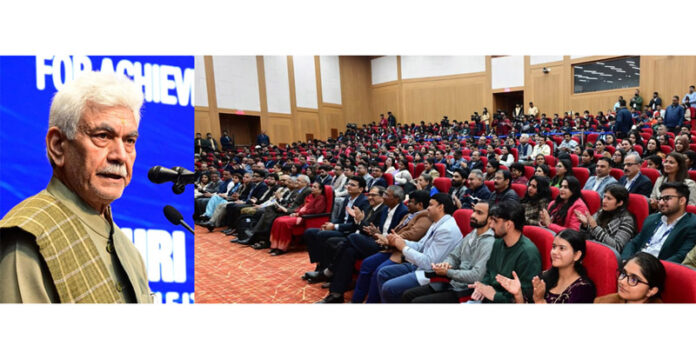
Lieutenant Governor Manoj Sinha marked a significant milestone on Monday, declaring that large parts of India have successfully reduced terrorism. During a three-day Strategic Management Forum (SMF) Conference at the Indian Institute of Management (IIM), Jammu, he noted a sharp decline in local recruitment into terrorist ranks in Jammu and Kashmir.
Sinha stated, “Large parts of the country have been freed from terrorism. Except for a few pockets, most of the northeast has become terrorism-free.” He emphasized that the threat of left-wing extremism and Naxalism, which once aimed to create a corridor from Hyderabad to Nepal, now only persists in two or three districts.
Regarding Jammu and Kashmir, Sinha highlighted that no high-ranking commanders from terrorist organizations are currently alive. He pointed out that local recruitment into terrorism has plummeted to an alarming low, with only one or two youths joining such ranks now.
He further accused Pakistan of persistently attempting to infiltrate terrorists across the border, stating, “Those coming from across the border are hiding in dense forests and mountainous terrain. I assure you they will be eliminated. No matter how long it takes, they will not survive.” This statement underscores the ongoing challenges posed by cross-border terrorism.
In recent years, the nature of terrorism has changed, with Sinha noting the involvement of more educated individuals. He highlighted that addressing terrorism requires a collective effort, not solely the responsibility of security forces. “Along with the security forces, society and certain wings of the administration must also contribute,” he asserted.
Sinha also called for an end to the divisive “insider-outsider” narrative. He expressed concerns that such thinking hinders the overall development of the region, calling for unity in pursuing progress.
During the forum, Sinha presented his vision for a developed India by 2047, underlining the critical role policymakers and business leaders play in navigating challenges and opportunities. He stressed the need for macroeconomic stability, extensive investments in education and health, participatory governance, and transparency.
He remarked on India’s unprecedented growth under Prime Minister Narendra Modi’s leadership, stating, “There is renewed confidence among industry leaders.” He noted that sectors like manufacturing and handicrafts are competing on a global scale as a result of the Prime Minister’s emphasis on Swadeshi.
Turning focus to Jammu and Kashmir’s economic potential, Sinha stressed the importance of utilizing the region’s rich mineral reserves, including limestone, sapphire, and lithium. “With strategic planning, we can generate an additional annual revenue of Rs 15,000 crore to Rs 20,000 crore in the next five to seven years,” he projected.
Additionally, he encouraged maximizing the hydropower sector and proposed amendments to the Holistic Agriculture Development Programme (HADP) to meet the region’s evolving economic needs.
On a cultural note, Sinha unveiled the Basohli Painting Exhibition, emphasizing its significance as a priceless artistic heritage. He expressed gratitude towards IIM Jammu and the Indira Gandhi National Centre for the Arts (IGNCA) for promoting this art form.
The event attracted various dignitaries, including Prof B.S. Sahay, Director of IIM Jammu, R.K. Chaudhary, Chairman of JERC J&K and Ladakh, and Subash Chandra Meena, Economic Advisor from NITI Aayog, among other industry leaders and artists.