

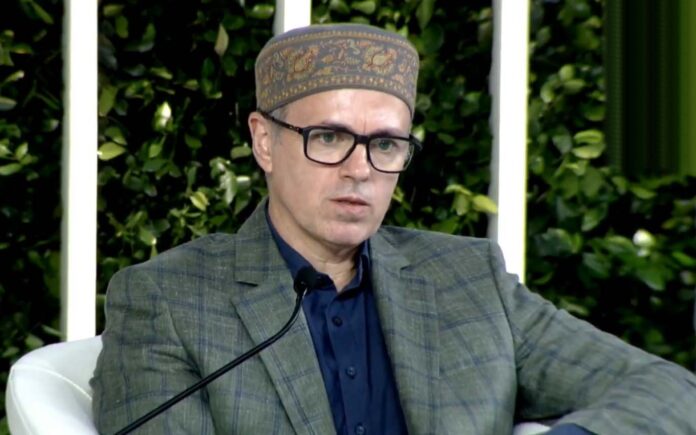
Jammu and Kashmir Chief Minister Omar Abdullah criticized the current administrative setup on Wednesday, calling his office one of immense disempowerment. In a public event organized by a national newspaper, he shared his sentiments about transitioning from the authority of an empowered State to a Union Territory with diminished powers.
Abdullah remarked, “I face the unique misfortune of leading a Union Territory with powers far less than any other State Chief Minister.” His strong critique highlights frequent interruptions by the Lieutenant Governor’s office, prompting him to demand a clear timeline for restoration of statehood.
Expressing deep frustration, Abdullah said, “It’s very difficult to reconcile the terms ‘Union Territory’ and ‘Jammu and Kashmir’ in the same sentence.” He emphasized his reluctance to categorize Jammu and Kashmir as a Union Territory, recalling a time when officials did not emphasize the ‘State’ in his earlier tenure.
The Power Struggle with the LG Office led to Abdullah’s assertion that the Lieutenant Governor, Manoj Sinha, appropriates roles that should traditionally fall to an elected government. He pointed out instances where Sinha oversaw matters such as chairmanship of the Jammu and Kashmir Power Development Corporation and tourism meetings, questioning, “What business does someone responsible for security have holding a tourism meeting?”
Further, Abdullah noted the appointment of an IAS officer to a post meant for the Jammu and Kashmir Administrative Services, striving to undermine the elected government. He raised concerns over pending cabinet decisions, including modifications to reservation percentages, remaining with the Lieutenant Governor.
With a focus on transparency, Abdullah insisted, “We see an asymmetrical allocation of power between the elected and unelected government. When are we going to address this?”
Statehood and Article 370 remain contentious topics. Abdullah reminded the Centre of the three-step framework it proposed for restoring statehood: delimitation, elections, and statehood, querying the delay for the final step. He challenged the Centre to clarify its definition of an “appropriate time.”
Directing his remarks to government officials, Abdullah stated, “If it is when the BJP comes to power, then be honest so people can decide.” He reiterated his commitment to advocating for the restoration of Article 370, albeit recognizing that its reimplementation will likely necessitate a change in the ruling administration at the Centre.
Abdullah warned that without considering humanitarian impacts, hyper-nationalism and collective punishment could exacerbate radicalization. Critiquing punitive actions, he referenced the demolition of homes after terrorist activities, questioning, “If those people are radicalized, whose fault is it?”
Additionally, he addressed recent controversies in Jammu and Kashmir regarding sports teams and medical admissions, where allegations arose concerning selections favoring Muslims, stating, “When you push an entire community to the margins, how can you expect no reaction?”
Breaking from his father’s view, Abdullah dismissed claims regarding EVM tampering. He reasoned, “We should own our defeats and correct our mistakes,” attributing electoral setbacks to constituency delimitation challenges rather than inaccuracies in the voting machines.
Economy, Environment, and Tourism formed part of his discourse as well. Abdullah discussed environmental concerns, particularly pollution’s impact and prolonged dry spells in Srinagar, aggravated by the valley’s unique geography. He sought to clarify misconceptions regarding tourism’s role, asserting that it ranks fourth in contribution to the Gross State Domestic Product of Jammu and Kashmir, following agriculture, horticulture, and industry.
By making important points about governance and regional status, Omar Abdullah’s commentary reflects broader concerns over power dynamics and potential restoration of statehood for Jammu and Kashmir.