


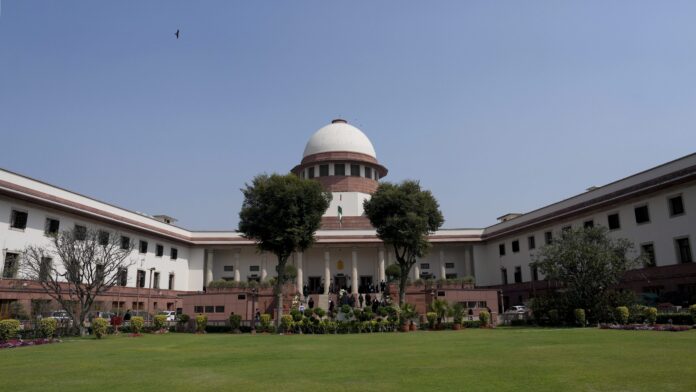
The Supreme Court of India has raised alarms over a growing trend where judges issue numerous judicial orders shortly before retirement. Chief Justice of India (CJI) Justice Surya Kant expressed this concern during a hearing on November 20. He compared the situation to a cricket batter ‘hitting sixes’ in the final overs, cautioning against this surge in judicial activity.
The remarks came while the Bench, which included Justices Joymalya Bagchi and Vipul M. Pancholi, considered a petition filed by a Principal District and Sessions Judge from Madhya Pradesh. The judge contested his suspension just 10 days ahead of his retirement scheduled for November 30.
“It is an unfortunate trend,” the CJI emphasized, noting the increasing number of orders passed by judges nearing retirement. He further illustrated his point by stating, “Petitioner, just before retirement, started hitting sixes.”
The judicial officer faced suspension on November 19, after the Madhya Pradesh High Court’s Full Court decision, linked to two judicial orders he passed shortly before this date.
Senior advocate Vipin Sanghi, representing the petitioner, highlighted the judge’s unblemished record, emphasizing that he consistently received commendable ratings in his Annual Confidential Reports (ACRs). Sanghi stressed that disciplinary actions against judicial officers should not occur merely for issuing judicial orders.
“How can an officer be suspended for judicial orders that are appealable and subject to correction by higher courts?” he questioned.
The Supreme Court aligned with Sanghi’s argument, acknowledging that typically, disciplinary proceedings do not target judicial errors. However, the CJI queried the legitimacy of the actions if the orders in question proved to be “palpably dishonest”.
On November 20, the Supreme Court directed the Madhya Pradesh Government to extend the retirement age for judicial officers from 60 to 61 years. This decision postpones the petitioner’s retirement to November 30, 2026. The CJI observed that the officer was unaware of this extension when he issued the controversial orders.
During the proceedings, the Bench inquired why the judicial officer had not approached the High Court regarding his suspension. Sanghi clarified that as the suspension stemmed from a Full Court decision, the officer deemed it more appropriate to appeal directly to the Supreme Court.
Notably, the Bench stated that Full Court decisions have been overturned by High Courts in prior cases. They also expressed disapproval regarding the officer’s request for information about his suspension through the Right to Information (RTI) Act, suggesting he should have submitted an official representation instead.
Ultimately, the Supreme Court declined to provide immediate relief. It granted the judicial officer the liberty to submit a representation to the Madhya Pradesh High Court, seeking a recall of the suspension order. The Bench instructed the High Court to evaluate and respond to this representation within four weeks.
This case serves as a poignant reminder of the delicate balance between judicial independence and accountability. The perceptions of judges acting hastily before retirement raise important questions about their motivations and responsibilities. As the Supreme Court continues to navigate these challenges, the legal community watches closely for precedent-setting rulings in this context.